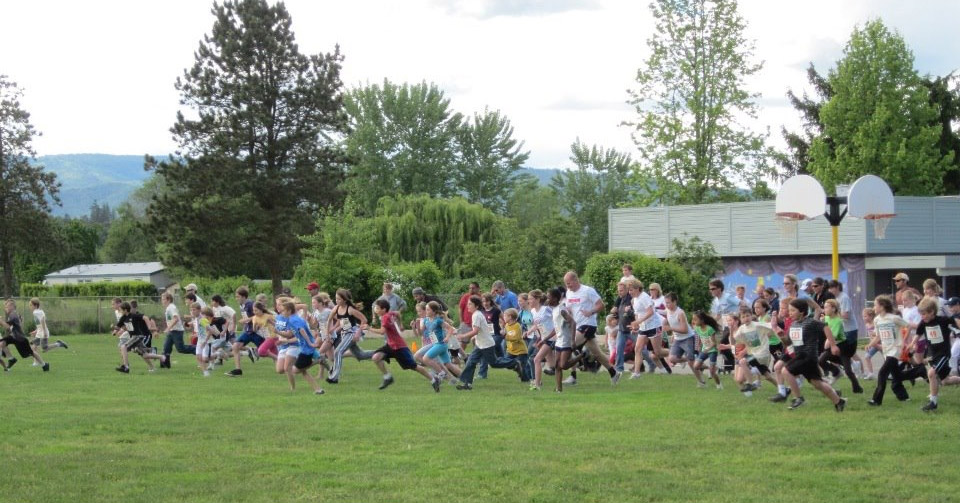
Today I was supposed to be running a 5K race. The Agony of DeFeet starts at 5pm on a Thursday in an elementary school yard in the outskirts of Medford, OR. There are maybe 200 people who compete, each of whom pay $5 or less to enter (early registrants are charged a full $3). The course passes by several horses, the roads are completely open to traffic, and there are no finisher’s medals or race T-shirts.
It is absolutely my favorite race of the year.
Over 40 years ago, my father, Jim Hoyer, founded The Agony of DeFeet to raise funds for PE equipment and playground maintenance at Griffin Creek Elementary, where he was a teacher at the time. I mean, come on, only a dad could have used that bad of a pun for a race name. But he loved running, and even more, was passionate about getting kids to be active and play sports. This event was one way he chose to share that passion, and make a small difference to his school and his community.
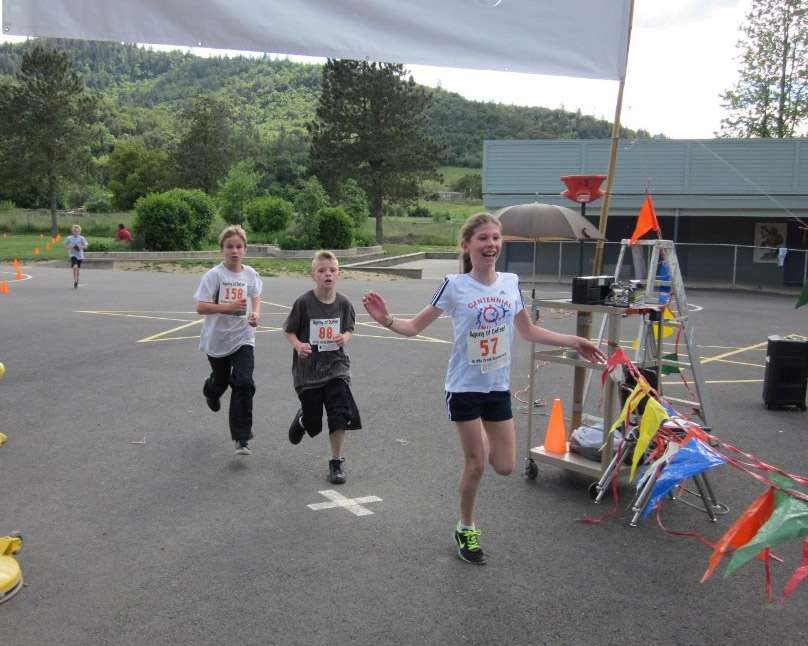
My dad passed away in 2001. That year, the school created a 2K companion event for elementary school kids, and awarded the Jim Hoyer Memorial Trophy to the top placing boy and girl. May 28, 2020 would have been the 20th running of that event. My plane ticket was booked and I was looking forward to returning to Medford to run this race and reconnect with the town. Unfortunately, because of COVID, the event has been cancelled.
A previous top elementary girl finisher,and winner of the Jim Hoyer Memorial Trophy.
I was disappointed. But then while I was out on a long run, I had an idea. To continue my dad’s lifelong passion of supporting kids’ physical fitness, and to thank the school for continuing his legacy for all these years, I’ve decided to create a fundraiser event…to which I may be the only donor. But you all play a part! Here’s how you can raise money for kids, just by being active…
For every person who runs 5K between May 28th and Father’s Day (6/21/20), I will donate $5 to the school so that they can continue to purchase playground and PE equipment, and maintain their track and activity fields. AND, if you get an elementary schooler (6th grade or under) in your life to run/walk a 2K, I will donate another $5.
I will donate up to $1000 to this cause (that’s 200 runners). Please make me give the school my money! You do something good for your health and the kids are supported in their play, fitness, and teamwork skills. WIN WIN!
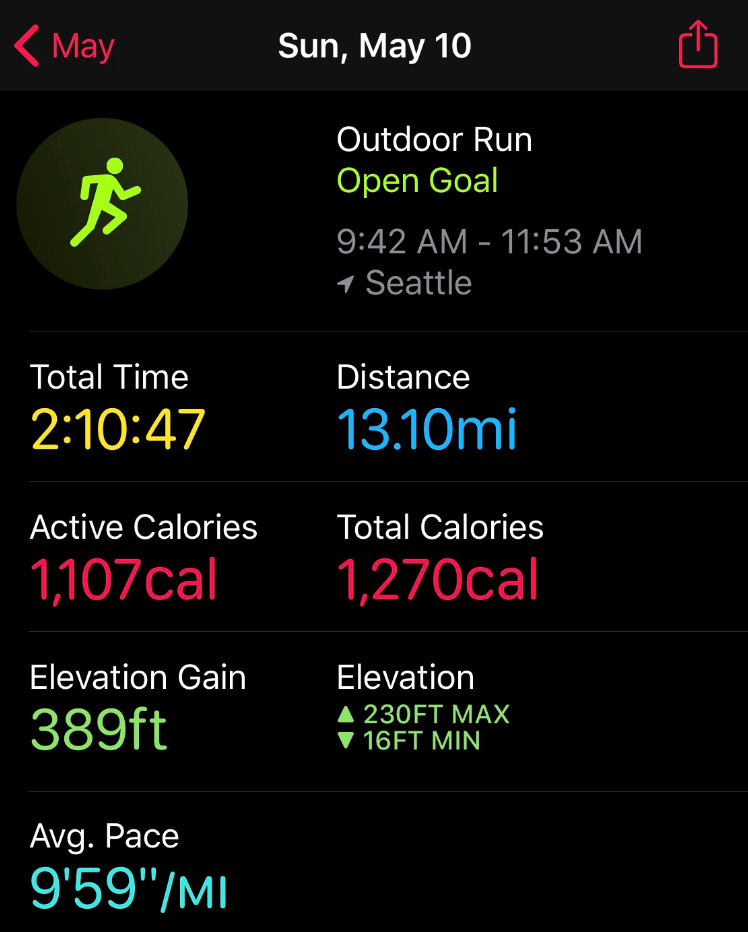
To ensure your 5K/2K efforts are rewarded with a donation to the school, please post or DM a screenshot of any fitness tracker showing your distance (time entirely optional…it is about doing it, not how long it takes you) to this blog, or to the SWIM BIKE BRUNCH facebook page. I’ll be making a donation each week based on the number of participants. Because I want to encourage many people to participate, there is only one donation per person. But please run as many 5Ks as you want to during this time!
And of course, if you’d like to add your own donation, that would be much appreciated! I’ve started a GoFundMe for this campaign. Please contribute any amount you feel comfortable with.
Thank you in advance for your participation and support. Happy running!
This past week I found out that it’s very likely that I will be working from home until Fall, and quite possibly the rest of the year. Some coworkers might go back next month. But because of the need to keep social distancing, the office of about 750 people has to prioritize who comes back first. I’m overall quite productive working from home, so it makes sense that I’ll be in a much later wave of those returning.
Overall, I’m fine with this news, and I know I have much to be thankful for. I still have a job and the company is doing very well, which is all too rare right now. On top of that, I no longer have a commute, it is much easier to get in a lunchtime workout, my dog gets a lot of attention, and I can basically live in comfortable athleisure wear (or pajama pants…that’s definitely happened on more than one day).
But for all the benefits, the downsides also became crushingly obvious. It will be a long time until things are back to “normal,” and not just at work. I really miss being out among people. Given the theme of this blog, it will come as no surprise that I love restaurants and bars. Meeting up with friends and family to have a quick drink or a lingering meal filled with laughter and catching up was such a core part of my life. And I traveled a lot. The fact that I can’t plan my next vacation, or even a three day weekend away right now is something I mourn. I also love browsing shops, taking live classes in things like cooking and sewing, and I really love my gym. My love for Orangetheory has been well documented in this blog. While the community at the gym is staying connected through facebook updates, group challenges, and online guided workouts, we all know it isn’t the same. All this makes me sad.
Since I’m unable to change the situation, I’m starting to come to terms with the fact that we are in this for a while, and the realization has set in that I need to start thinking long term. At home I’m starting to do things like invest in a nice office set up, one where I can feel productive for months. But I’ve also been shifting my exercise routine to focus on the long term as well. I’ve started to take a big step back from a focus on speed, because what race am I actually training for right now? Instead, I’m using these couple months to target something even more critical: base training.
Base training focuses on gaining endurance. But it isn’t just about running or biking longer distances each week. True base training reprograms your body and changes the way it burns fuel. To give a very general overview of the science (stick with me…I promise I’ll be pretty quick), the focus is on keeping your heartrate below your lactate threshold, where your body is able to burn fuel at a sustainable rate. When you cross this threshold, your body starts to fatigue and can’t sustain that effort for a prolonged period of time. There are differences between this and your aerobic threshold that some people can geek out about. But for most people’s purposes, thinking about lactate threshold as that time when you become anaerobic is sufficient. The goal is to keep your heartrate low enough to be able to sustain increasingly longer workout sessions. Over time, if you consistently train below your lactate threshold, it is possible to feel as good running ten miles as you currently do running three. I promise.
I will follow this post up soon with another that dives a bit deeper into reasons you should commit to doing a period of base training if you want to avoid injury and move closer to your peak performance. But if you can trust me on that for the moment, the really good news is that this is the perfect time to do it!
In March I was maxing out at about 7 mile runs. By gradually adding mileage over the weeks, I just hit half marathon distance. That pace is key: way slower than if I were trying to race it.
Right now, almost none of us can go to the gym to keep up with our former, usual routine. As I’ve said many times, I love Orangetheory (I mean, this isn’t even the first time I’ve said it in this post). I see really good results in my muscle composition, overall fitness, and definitely in my running speed. But Orangetheory and most other gym workouts don’t really provide endurance training. Sure, they call some workouts “endurance days.” But when that time is limited to, at most, 25 minutes of your workout, it isn’t going to continue to expand your endurance beyond that point. So people who go to such workouts exclusively could become really strong 5K runners, but will have a hard time with any event that takes them more than that 25 minutes. And even those wanting to focus on being 5K runners will be better in the long run if they spend six to eight weeks focusing on base training before they start incorporating high intensity intervals. So while I miss my gym routine, I’m taking this down time as a chance to focus on gaining more endurance, both to ultimately run a faster 5K, and also with an eye toward working my way back into being a decent half marathoner.
Whether you are bemoaning the loss of your favorite gym workout, or maybe looking to start a fitness routine from scratch, I’d encourage you all to slow it down for a bit. We have to start thinking long term with our new COVID reality. It’s also a perfect time to reorient your fitness goals and start thinking lower intensity, longer distance. Longer, slower distances might not be as sexy as sprint intervals, and they do take more time and dedication. But it does pay off. When our gyms open up and communities can once again host races, we will be ready to push our bodies even further and achieve even greater performances. Until then, we’re in this for the long haul…together.
Are you missing something in particular from your old routine? How are you adjusting to the the extended projections for Stay at Home? Share your thoughts, ideas and insights!
One more week of work from home is complete, and with it came more heightened restrictions on our activities. Washington State, where I live, joined the growing list of states mandating Stay at Home or Shelter-in-Place. With that, however, came the potentially confusing encouragement to go outside for exercise and emotional wellbeing. “This does not mean you can’t go outside,” said Governor Jay Inslee in his televised address. “If you feel like going for a walk, gardening, going for a bike ride, we consider these things essential activity too for everyone’s physical and mental health.”
I was relieved that this was
allowed, since I’m pretty desperate to keep up some kind of normal exercise
routine throughout this. But it also brought up a lot of questions: Is it
really safe? How much can I be outside? Am I being selfish if I head outside to
make myself feel better?
After several days of researching and trying things out, I’ve
realized I can both go for a run outside and be responsible, but it takes some effort
and diligence. The biggest reason is that, while you and I may be committed to Social
Distancing, many others still aren’t. Many people make no attempt to alter
their path on a sidewalk. I’ve waited for crosswalk lights and had people come stand
right next to me. And this week, a group of guys playing pick-up basketball
(already a bad choice) asked if I could throw their ball back to them when it
rolled toward me. I said “Sorry,” then charted a six foot course around the
germ ball and kept running.
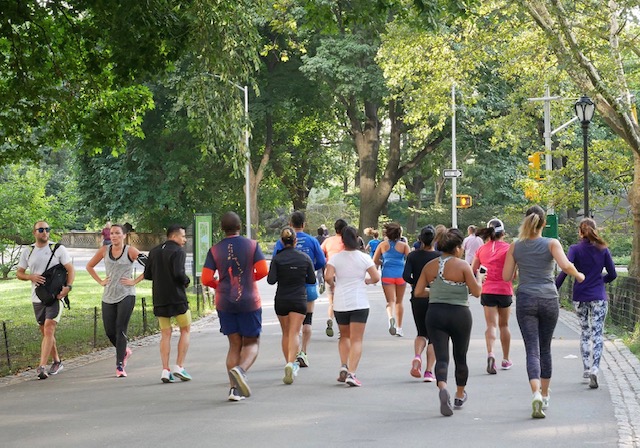
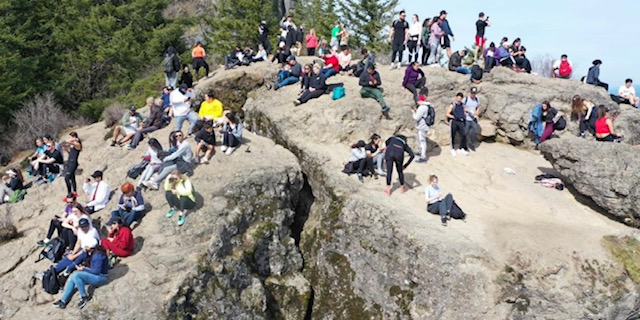
All these people made it to this crowded spot by walking on a three foot wide path…after being warned to social distance.
So to help more of us avoid situations like this, here are a few tips I’ve gathered from a combination of research and personal experience. They’ve helped me significantly limit my encounters with those who, inexplicably, have still not gotten the social distancing memo.
Get creative with your routes
Humans like doing things they feel comfortable with. So,
when looking to get outside and stretch their legs, most head to a park or
familiar trail. That’s exactly why you should go elsewhere. Last weekend I made
the mistake of trying to go for a run along the Lake Washington waterfront,
where I and a lot of others run, bike, and walk frequently. I got within about
100 yards of the route and realized I needed to find another option. I saw
dozens of people passing each other within inches, groups walking three or four
abreast so that anyone wanting to pass them at a six foot distance found
themselves in the middle of the street, and a handful of children playing on
the playground right next to the path. While I sympathize with parents who need
to find an outlet for their kids’ pent up energy, until someone invents
antimicrobial monkey bars, you really need to keep your kids off the jungle gym
during a pandemic.
Not a great place to run when you want to keep your distance from others.
So have some fun exploring new routes. You can plan out a new route on your laptop in advance using one of many online tools such as Map My Run or Google Map Pedometer. Or head out and just enjoy new streets. If you normally run on Main, try going one or two blocks over. Make a game of finding a one mile loop in your neighborhood that uses all side streets. As a bonus, these streets tend to have fewer lights, so you don’t have to stop or slow down as often and there are fewer buttons to have to touch at crosswalks.
Avoid peak hours
A pretty great way to avoid people on your run or walk is to
do it early in the morning, or after dark. And, from my experience, the people
who are out at those times tend to be more diligent about their social
distancing. The oblivious texter who doesn’t look up to see who’s around and can’t
hold a straight line is out in droves on a weekend afternoon. So avoid them by
going M/W/F at 6:45am.
If mornings are just not your thing, consider becoming a post-sunset runner. With nobody coming home from bars and restaurants, the sidewalks are basically a few other runners and the occasional dog walker. But if you go this route, be prepared. Dress the part in bright, reflective clothing that is warm enough for the nighttime drop in temperature. And consider investing in a head lamp, particularly if the streets near you aren’t well lit. You can buy a really decent headlamp and reflective vest for around $25 each at a lot of online retailers. If your local running store is filling online orders, consider supporting them to help them through these tough economic times.
Rain is a good thing
Much like running at dawn and darkness, running in the rain is
a much more solitary experience. Most people won’t even consider going for a
run or walk if they are going to get wet. So, if your fitness is your priority,
purchase a good waterproof outer layer and head out into the empty streets.
Bring your own water
That drinking fountain on your route? Hard pass.
Run single file
If you happen to be lucky enough to cohabitate with a
running or walking partner, enjoy the company. But if you are anywhere near
other people, be courteous and shift to single file so that passing at a safe
distance is easier. That couple walking the other way may not be paying you the
same courtesy, but you can only control you. Let your moral superiority fuel
your next half mile.
Consider leaving the electronics at home
I really like running without music. It is my chance to be
alone with my thoughts and I appreciate the quiet. I do realize that many
people love their soundtrack, though. Just be aware that this makes it harder
to hear people coming up behind you, or ones around the corner. So maybe turn
it down a tad. And if you are out for a walk, remember that the thing that
makes this time an “essential” activity is your health and mental wellbeing,
not that you took a selfie, or texted with your bestie, or caught that
Charmander. Being heads down on your phone makes you less aware. Don’t be that
oblivious person from Tip #2. And a reminder that any germs you happened to
pick up from forgetting to not touch the railing or crosswalk button will now
be on your phone. If you don’t need it, leave it at home and enjoy the scenery
around you.
Follow the rules of the road
This is a longshot because it requires mass adoption of this
practice. But I’m putting this notion out into the ether in hopes that it will
spread. If we all walked and ran on the sidewalk on the right side of the
street (or left side if you are in England or one of those other left side
driving countries), we would pass VASTLY fewer people. Cars don’t drive in opposite
directions on the same side of the road for obvious reasons. But most people
never think about it when on the sidewalk. But particularly now, it would
really help us come into contact with each other far less.
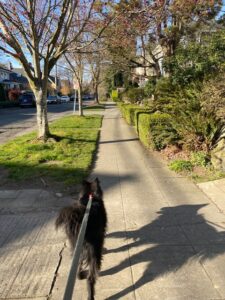
Following the Rules of the Road on a quiet street.
If two people approach each other on the same side of the street, they are guaranteed to have to pass one another. But if you are traveling the same direction as that person, even if you are going somewhat different speeds, there is a large chance one of you will turn off the street before either of you overtake the other. And if you do overtake someone, you have a lot more time to plot out a good spot to do so that is safe and has plenty of clearance.
So try it out, and spread the word. Pedestrian Rules of the Road should be a common practice everyday, but particularly in a pandemic.
. . .
It should hopefully be obvious that none of this matters if you or anyone you live with is showing symptoms. If you are sick or may be sick, stay home. Take care of yourself, and in so doing, take care of the rest of us.
But assuming you believe you are healthy and in need of exercise, consider incorporating one or more of these practices on your next run or neighborhood stroll. You won’t just be helping you, but all the other people out there trying to find their social distancing path.
And I’m sure there are more tips. Please add yours to the comments! I may even incorporate some of them into a future blog post. Because remember, right now we run solo, but we get through this together.